Where to stay in Tuscany with family is the decision that shapes everything else about the trip, and most people get it backwards. The instinct is to start with a list of towns. Florence for the art, Siena for the piazza, a hill town or two for the views, maybe a vineyard day. It feels thorough. It is actually the mistake. Tuscany rewards depth, not coverage, and a list of towns without a base turns into long drives, tired kids, and tense adults wondering why a place this beautiful feels this hard.
The real decision is where you anchor yourselves. Choose well and the days flow on their own. Short distances, a rhythm everyone can keep up with, room to do less and actually enjoy it. Choose badly, and the itinerary runs you instead of the other way around.
Tuscany offers five genuinely different answers. Chianti, Val d’Orcia, the Maremma, the Versilia coast, or a city itself. None of them is universally right. The right one depends on your children’s ages, how much driving everyone can tolerate, whether a beach day is non-negotiable, and what this trip is actually for. That is what the rest of this comes down to.
CHOOSING THE RIGHT BASE FOR YOUR FAMILY IN TUSCANY
why the location matters more than the itinerary
Where you base yourself in Tuscany determines almost everything else about the trip, more than any single attraction or town on the list.
This is because Tuscany is not one place. It is countryside, coast, art cities, medieval hill towns, and areas most visitors never think to look for. Base yourself in Florence and you have the art and the architecture at your door, but the rolling countryside everyone pictures when they imagine Tuscany is now a day trip, not a daily reality. Base yourself in Val d’Orcia and the opposite is true. The landscape is exactly what you came for, but the cities become planned excursions rather than casual afternoons. Want the coast as well, or one of the quieter, less obvious corners of the region? That is its own decision again, and it does not automatically follow from the first one.
None of this means you have to choose only one version of Tuscany for the whole trip, though staying longer in fewer places works better than trying to cover everything at once.
Subregions can be combined well. Chianti and Florence is one combination that works, but it is far from the only one. What actually determines the right mix is trip length, who is travelling, what everyone expects from the days, and whether there is a specific occasion or reason behind the trip that should shape the pace. A ten-day trip with grandparents in tow plans very differently from a week with teenagers who want to be doing something every day. There is no default formula, only the right combination for that particular family and that particular reason for travelling.
The five regions that follow, Chianti, Val d’Orcia, the Maremma, the Versilia coast, and Tuscany’s cities, are not five versions of the same trip. They are five different trips. The right one, or the right combination, depends on what kind of Tuscany you actually want to experience and how much movement between them you are willing to build into the itinerary.
WHY I BASE DIFFERENT FAMILIES IN DIFFERENT PARTS OF TUSCANY
real examples of the decision in practice
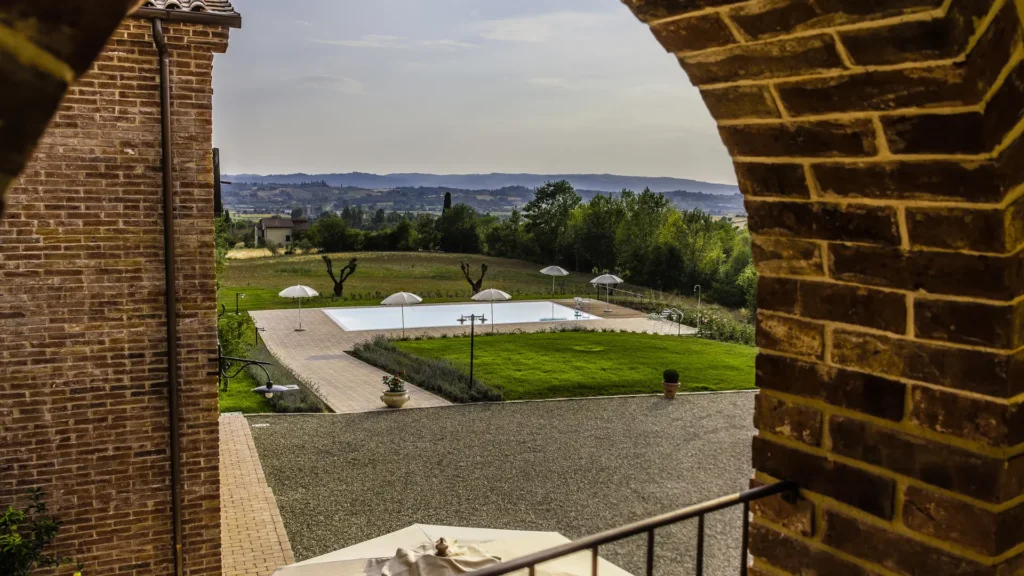
A family of two parents and two adult daughters came to me wanting a relaxed countryside trip, no major sightseeing, somewhere they could slow down rather than move through a checklist of towns. That brief made the subregion choice straightforward. Val d’Orcia is built for exactly that kind of trip, and I based them at a historic countryside estate with a pool, between Val di Chiana and Val d’Orcia, for three nights.
From there they did a private e-bike tour through the landscape with a picnic along the way, took an early morning hot air balloon flight, and spent an afternoon at an organic farm near Pienza for a private cheese tasting, seeing the full closed production chain from the animals through to the finished Pecorino. They also had dinner one evening at a restaurant on a Michelin list that built its menu entirely around local produce. None of it required moving between bases. The trip they wanted was already built into where they were staying.
Another family, with four children between six and eleven, spent six nights at a working farm on the Tuscan coast near the Maremma. I built the snorkelling experience around the children’s specific ages, and for the horse riding I chose a private ranch with 80 hectares of land, since children under 14 cannot ride on public roads in Italy and this let them have the experience safely and within regulation. They had two pools, treehouses, a playground, beach days, a day at a local amusement park, several meals at typical trattorias nearby, and genuine time with the farm’s own animals and orchards.
The base gave them both countryside and sea without needing to move. From there they continued to Pisa for two more nights, with a day trip to Lucca, for a total of eight nights across two Tuscany bases in a single trip.
A third family, two teenagers travelling with their parents, based themselves in central Florence for three nights, at a hotel genuinely fifteen minutes from the city centre but a world apart from the crowds that define most of Florence’s tourist core. They still got a full day in the Tuscan countryside through a bike tour that left the city and came back. Most families who base in Florence never leave the art and the streets. This one got both the city and the countryside from a single base, because the day was planned properly around it.
Three different families, three different reasons for choosing where they stayed, and three completely different versions of Tuscany. None of them was a compromise. Each base matched what that particular trip was actually for.
Those three families settled on three different bases because they wanted three different things. The same logic applies to where to stay in Tuscany with family, whatever your own family is hoping for.
CHIANTI
the wine region between Florence and Siena
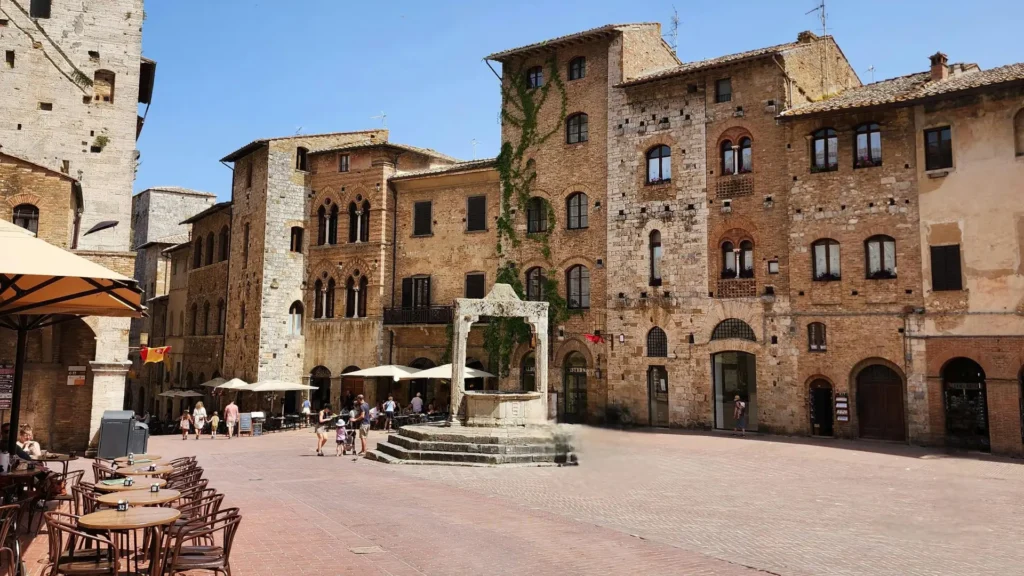
Chianti sits between Florence and Siena, which is exactly what makes it work as a base. Greve in Chianti, the region’s main gateway town, is roughly 30 kilometres, or about 20 miles, from Florence, and the drive to either Florence or Siena takes around an hour. You can also plan both cities as day trips, though one day only ever scratches the surface of either city.
There is no single right way to combine them. Some families base in Chianti and treat Florence and Siena as day trips. Others split the stay, a few nights in Florence and a few in Chianti, with Siena visited along the way. The right combination depends on the family’s interests, how long the trip is, and how much moving between bases everyone is genuinely willing to do.
The food and wine culture here is part of daily life rather than something you book as a single activity. Small towns throughout Chianti are built around exactly this, vineyards, local trattorias, slower mornings, with Florence or Siena available whenever the trip calls for a city day.
VAL D’ORCIA
the UNESCO landscape that defines Tuscany
Val d’Orcia sits closer to Siena than to Florence, though exactly how close depends on which town within the area you base yourself in. The region is made up of several small towns, Montalcino, Pienza, Bagno Vignoni, San Quirico d’Orcia, Radicofani, and Castiglione d’Orcia, each with its own character but all sharing the same rolling, cypress-lined countryside that earned the UNESCO designation in the first place, and the landscape that most people picture when they imagine Tuscany. Montepulciano, just over the border in Val di Chiana, is often used as a gateway into the area.
This is not a region built around easy day trips to a major city. It suits families who want the landscape itself to be the experience, slower mornings, vineyards, small towns rather than museums, with food and wine woven into daily life rather than treated as a single outing. The countryside itself also invites outdoor time, cycling, walking, exploring on horseback or by bike, in a way that is harder to build into a city-based stay, and it’s exactly the kind of experience that actually delivers when the base is right.
MAREMMA
coast, countryside, and off the beaten track
Maremma is roughly a 90 minute drive from Rome, and around two and a half to three hours from Florence heading southwest, which makes it a different kind of base from anything further north in Tuscany.
The region itself is large, over 5,000 square kilometres, or close to 2,000 square miles, and is generally split into three parts. The northern stretch hugs the coastline of the Pisa and Livorno provinces, with dense woodland and wine country inland. The central area, around Grosseto, is where the long sandy beaches and protected coastal marshland sit. The southern part, bordering Lazio, is home to the dramatic tufa-rock towns like Pitigliano, the volcanic slopes of Monte Amiata, the thermal waters at Saturnia, and the Monte Argentario peninsula.
What this means in practice is that Maremma covers genuine coast and genuine countryside within the same broad region, which is exactly why it suits families wanting both without needing to change base partway through the trip, the way a family I planned for combined a working farm stay, beach days, and inland horse riding from a single property on this coast.
VERSILIA
for a beach based holiday in Tuscany
Versilia is the northern stretch of the Tuscan coast, centred around Forte dei Marmi, and it suits families planning a beach based holiday where the sea is part of every day rather than a single excursion. The beach clubs along this coast, the lidi, are a genuine Italian institution. Lucca and Pisa are both about 45 minutes to an hour away, close enough for a day trip inland without the beach holiday losing its rhythm entirely, and the marble quarries of Carrara are nearby too, a genuinely different kind of outing for families who want to see where some of Italy’s most famous stone actually comes from.
Cinque Terre is also within reach, just over an hour by car or by a seasonal boat excursion along the coast, which makes Versilia a workable base for families who want both this coast and a taste of Liguria without changing where they sleep.
Versilia is not only beach. Viareggio’s seafront still carries its early twentieth-century character, the Liberty style buildings that once housed bathing establishments, cinemas and cafes. Inland, the Apuan Alps offer genuine hiking for families who want a break from the sand, and Versilia’s pine forests give a cooler, shaded alternative on the hottest days of summer.
Because the appeal here is largely about settling into a rhythm, this is not a base that suits a short stop. Four to five nights is closer to what makes sense, enough time for the beach days to actually feel like a holiday rather than a stopover on the way to somewhere else.
Outside the beach season, Versilia takes on a different character entirely. Viareggio hosts one of Italy’s best-known Carnival celebrations every February, a reason in its own right to visit the town even when the sea is not the point of the trip.
CHOOSING A CITY AS YOUR TUSCANY BASE
Florence, Siena, or Lucca
Florence, Siena, and Lucca are all genuine options for families who want a city as their base rather than the countryside, but they are not interchangeable. Florence is the cradle of the Renaissance, and basing yourself there puts the major art and architecture of Tuscany within walking distance, alongside a lively, busy atmosphere that comes with being the region’s biggest draw.
Siena is medieval rather than Renaissance, with its own distinct character, and if the dates line up, the Palio, the historic horse race run twice a year in the city’s central square. It is just as lively as Florence in its own way, but on a smaller scale. A base in Siena also puts San Gimignano within reach, around 40 minutes away, and a day there works well combined with a wine tasting or a cooking class nearby.
Lucca is also medieval, more compact than either Florence or Siena, and a genuinely less obvious choice for a family that wants a city base without the volume of tourists that Florence and Siena both attract. From Lucca, San Miniato is a similarly easy day out, around 40 minutes away and known for its truffle hunts, a more hands-on alternative to another day of museums and piazzas.
WHERE FAMILIES GO WRONG CHOOSING A TUSCANY BASE
three mistakes, and how to avoid making them
Most families I plan for make one of the same three mistakes when deciding where to stay in Tuscany with family, and all three are avoidable once you know to look for them.
The first is not realising that Tuscany is not one region but several distinct ones, each with its own character, distances, and rhythm. Without that understanding, a trip gets planned as a list of places rather than a structure, and many families end up backtracking between towns trying to cover as much as possible. Once you understand that Tuscany is made up of genuinely different subregions, the plan changes. You choose where to anchor yourself first, and the list of places follows from that, rather than the other way around.
The second is choosing a remote villa without checking what it actually demands from you on a daily basis. The photos can be perfect, and the property can still be the wrong choice if nobody has looked at what surrounds it, the distance to the nearest shop, bar, or trattoria, whether there is any concierge or on-site support, and how that plays out for the specific ages of the people travelling. A property that works perfectly for a family with grown-up children can be genuinely difficult for grandparents or young children. None of this is visible in a listing. It only becomes visible once you check it properly before booking, not after you arrive.
The third is the most common, and the hardest to notice while you are doing it. Choosing a base because a generic list ranked it highly, rather than because it actually fits your family. A list cannot know how long your trip is, who is travelling, what your children are interested in, or what this particular trip is supposed to be for. The right base for a couple celebrating an anniversary is not the right base for four grandparents and six grandchildren, even if both found the same article ranking the same five towns.
Avoiding all three comes down to the same thing. Decide what this trip is actually for before you decide where to stay, not the other way around.
This is also where villa vs hotel in Italy becomes a real question worth asking before you book, and why getting around Italy without the logistics stress matters just as much as the property itself.
HOW I HELP FAMILIES CHOOSE A TUSCANY BASE
the questions that actually matter
You probably come to where to stay in Tuscany with family after hours of searching and feeling no closer to an answer. Every blog post recommends a different town, every list ranks the same five places in a different order, and none of it actually tells you which one is right for your own trip. The decision is part of how the best Italy family vacations are really planned, not a separate problem to solve on its own.
What I actually look at is more specific than any list can be. What you and your children are genuinely interested in, art and history, food and wine, the outdoors, the sea. How far you are realistically willing to travel for a day trip, and how that maximum distance changes depending on who is in the car. Whether the trip is built around sightseeing or around slowing down, since those two things rarely sit well in the same base.
How long the trip actually is, since a four-night stay and a week stay can justify very different decisions. And how you want to move once you are there, because if you do not want to drive, the countryside needs to be planned completely differently, often with private transfers built in, while a city base opens up train travel between Florence, Siena, and Lucca with much less friction.
Tuscany is genuinely hard to plan well, and it stays hard for two separate reasons. The first is choosing the right subregion for your family specifically, which is everything covered above. The second, just as important, is keeping in mind how that choice fits into the wider Italy itinerary you are actually building, since Tuscany is rarely the only region on the trip. Getting the first right and ignoring the second is why so many families ask whether it’s worth planning Italy without specialist help, and is how you end up with a perfect few days in Tuscany that does not connect well to anything else.
“Vanya created an incredible itinerary taking into account all the information I gave her about my family’s interests and had every aspect of the trip covered. The bike tour and hot air balloon rides were highlights and the private guides were first class. To say a 10 day trip went off without a hitch is to say a lot.”
— B. Teaster, USA — family with grown children, Val d’Orcia
“We checked into a farm style hotel with outdoor pools and views to die for, just a few minutes from the local beaches and town centre. All activities were already thought of and booked, we just showed up, snorkelling and horse riding, a picnic in the countryside, evenings in town with the funfair. The attention to detail made it possible for us all to have a relaxed family holiday.”
— L. Burke, UK — family with four young children, Maremma
If Tuscany is the centrepiece of a family holiday in Italy you are planning, this is the decision worth getting right before anything else.
WHERE TO STAY IN TUSCANY WITH FAMILY
questions worth answering before you book
Where is the best place to stay in Tuscany with family?
There is no single best place to stay in Tuscany with family, and any answer that gives you one town is skipping the actual decision. Tuscany has five genuinely different bases worth considering, Chianti, Val d’Orcia, the Maremma, the Versilia coast, or a city itself, and each suits a different kind of trip. The right one depends on whether you want countryside, coast, art and history, or some combination, how long you are staying, and how much driving everyone is willing to do.
Is Chianti or Val d’Orcia better for families?
Both work well, but for different reasons. Chianti sits close enough to Florence and Siena that you can treat either as a day trip without committing to the long drives that come with a more remote countryside base, which suits families who want some city time without giving up the countryside entirely. Val d’Orcia is more committed to the landscape itself, slower mornings, vineyards, small towns rather than museums, and it suits families who are happy to stay further from a major city for the week.
The right one depends less on who is travelling and more on how much city time you want built into the trip, and how far you are willing to be from Florence or Siena on the days you do not plan to visit them.
Do you need a car to stay in the Tuscany countryside with kids?
In most of the Tuscany countryside, yes. Chianti, Val d’Orcia, and the Maremma are all built around small towns and rural properties that are not realistically reachable without one. A city base, Florence, Siena, or Lucca, is the exception, since you can walk within the city and use trains to reach the other two. If you do not want to drive with children in the car, that single preference should shape your choice of base more than almost anything else, since it can rule out the countryside entirely or change how that countryside stay needs to be planned, often with private transfers built in rather than self-driving.
Which Tuscany base works best for a multigenerational family trip?
Multigenerational trips, three generations from grandparents to grandchildren, generally need more space and more privacy than other family trips, since different generations want the ability to be together and apart on the same day. A villa with multiple bedrooms and shared outdoor space in Val d’Orcia or Chianti often works well for this. An agriturismo with independent units can work just as well and adds on-site staff and a restaurant, which keeps the group anchored together rather than isolated across a large property. If you are planning a multigenerational Italy trip, the base decision tends to matter more here than for any other family configuration.
Should families base themselves in Florence or the Tuscany countryside?
Where to stay in Tuscany with family, Florence or the countryside, depends on what you actually want from the trip, not on which option sounds more authentically Tuscan. Florence gives you the art, the architecture, and the energy of a major city, and a good Florence base can still get you a full day in the countryside through the right day trip. The countryside- Chianti, Val d’Orcia, or the Maremma- gives you the landscape and the slower pace as a daily reality rather than a single excursion. Families who want both often split the stay rather than trying to force one base to deliver everything.