Is Parma worth visiting when planning a northern Italy itinerary? The short answer is yes, and most itineraries still miss it. Not as a compromise when the main stops are full, not as a half-day detour from Bologna, but as a destination that earns its place on its own terms.
Most Italy trips miss it entirely. The Food Valley – Parmigiano Reggiano dairies, Parma ham curing cellars, Lambrusco producers – sits within easy reach of the city and almost nobody builds it in. The Correggio dome in the Cathedral is one of the most technically extraordinary ceiling paintings in Italy and one of the least visited. The wooden Teatro Farnese inside the Palazzo della Pilotta is a 17th-century theatre built entirely in wood that most visitors to Italy never find.The city is compact, walkable, and genuinely easy with children, cafes and bars throughout the centre, short distances between everything worth seeing, no hills.
I know Parma well. I have visited several times from Milan, less than an hour by high-speed train or a straightforward drive, and have planned Food Valley itineraries for clients. Depending on how an itinerary is structured, it works as a city escape, a day or two in the centre, or as the base for a deeper Food Valley experience. Here are five things most Italy itineraries miss.
THE FOOD VALLEY
what a Parmigiano Reggiano dairy and a Parma ham cellar actually look like
Parmigiano Reggiano has a moment. It happens at 9 in the morning, when the curd is lifted from the vat and the wheel begins to take shape. The timing is dictated by nature. It cannot be moved earlier or later. If you arrive after it has happened, you get the explanation. If you are there at 9, you witness it.
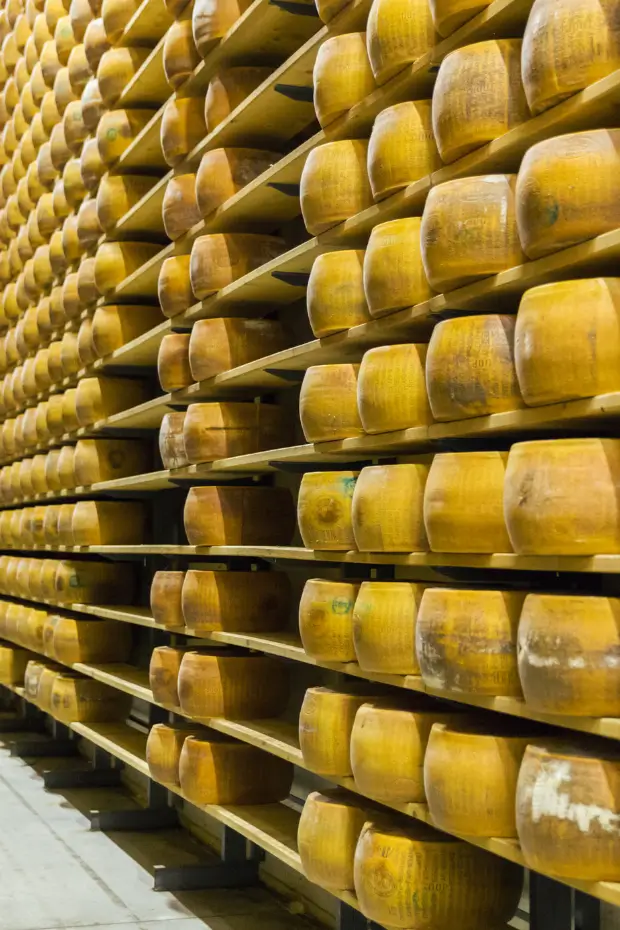
A private tour of a biological Parmigiano Reggiano dairy outside Parma covers what most visitors never see. The dairy runs what the Italians call a filiera chiusa, a closed supply chain from the grass in the fields to a wheel aged 100 months. The tour covers the full process, the animals, the dairy floor, the ageing cellar with its walls of wheels stacked floor to ceiling, and the opening of a wheel with the traditional almond-shaped knife. The tasting at the end includes cheeses of different ages. It takes most of the morning, and it should.
The Parma ham side of the Food Valley is a different day entirely. Inside a curing facility, the legs hang in temperature-controlled rows, hundreds of them, floor to ceiling. The process takes a minimum of 12 months, up to 24 for the finest Prosciutto di Parma. Each stage has a name and a purpose, the salting, the resting, the application of the sugna paste that seals the exposed meat, the final inspection that determines whether a leg earns the Parma ham fire brand. It is not a visit you find on a standard booking platform.
The Food Valley is not a half-day activity. Treating it as one is the most common mistake I see in northern Italy itineraries. A Parmigiano Reggiano dairy and a Parma ham producer are two separate visits, and two completely different windows into a food culture that has been producing the same things in the same way for centuries. Rushing it misses the point entirely.
9-DAY FOOD AND WINE ITINERARY
Bologna, the Food Valley, and Lake Garda — a complete northern Italy food and wine route.
GET THE ITINERARY
THE ARCHITECTURE AND CULTURE
the Cathedral, the Baptistery, and a 17th-century wooden theatre worth your time
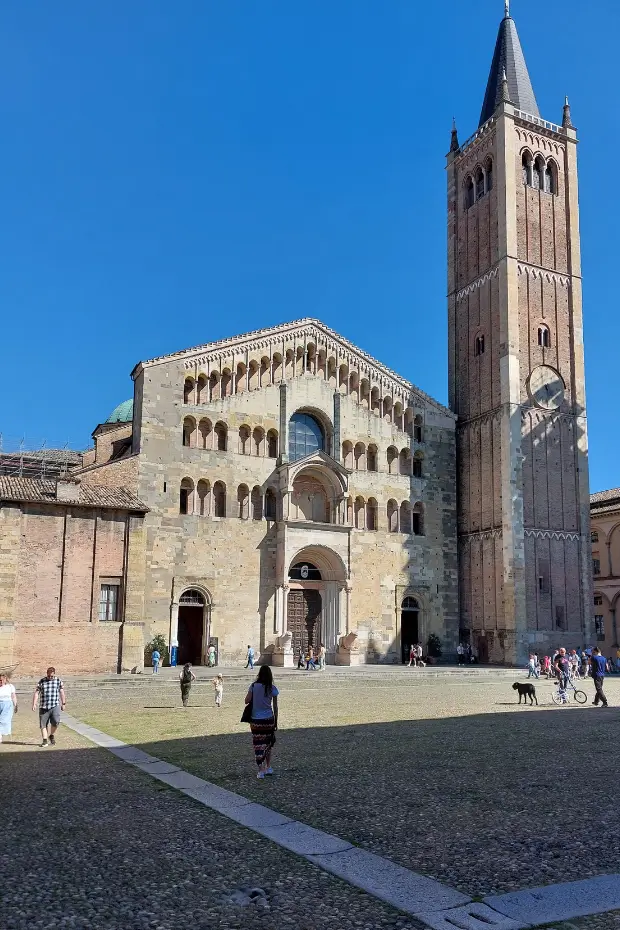
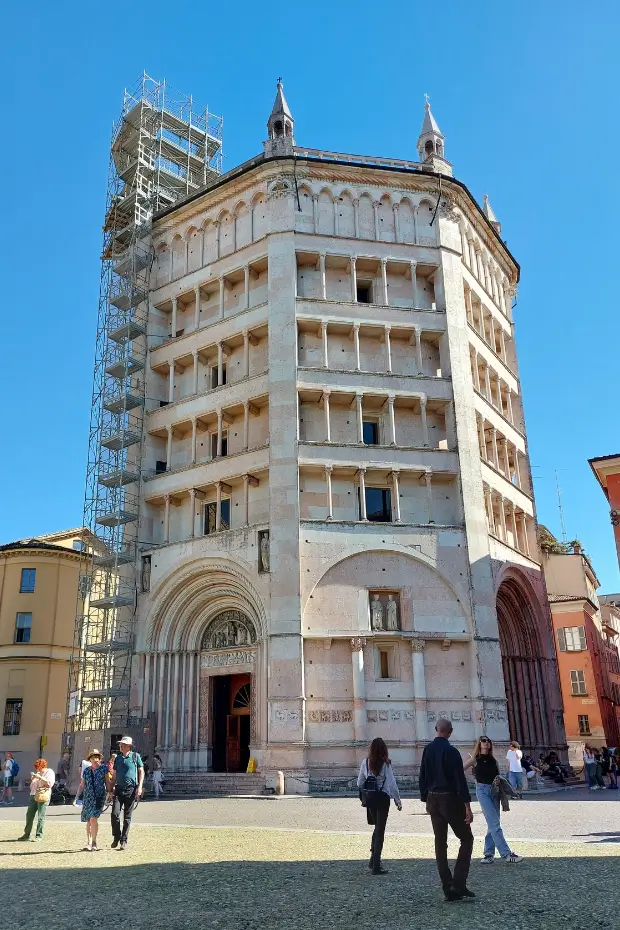
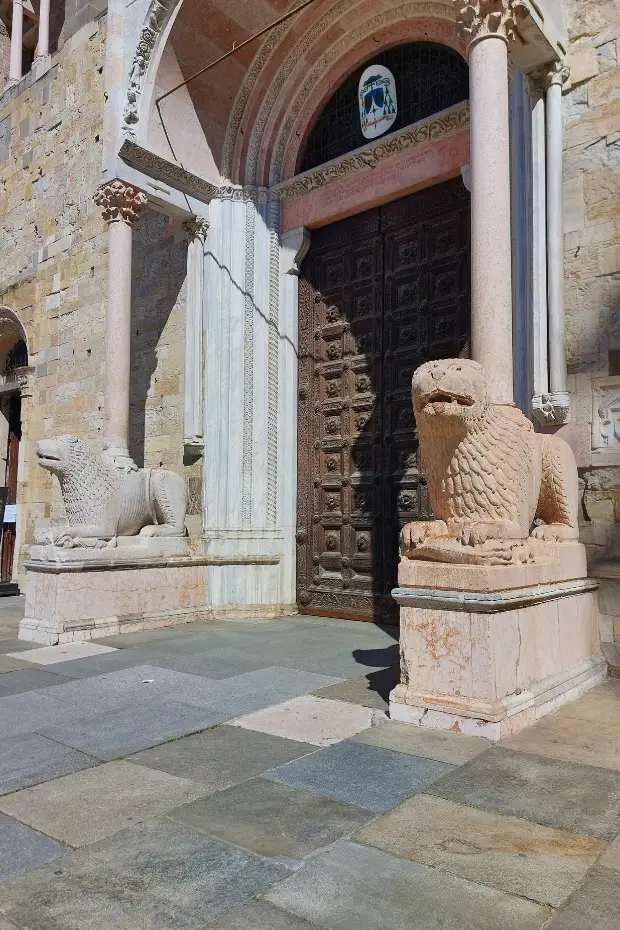
The Cathedral and the Baptistery sit at the heart of Parma’s historic centre, close enough to each other that most visitors see both in the same morning. The Cathedral is Romanesque, built in the 11th century, with a facade that reads as restrained until you step inside. The Baptistery is octagonal, built from pink Verona marble, one of the finest examples of Romanesque-Gothic architecture in Italy. Together they anchor the Piazza del Duomo, one of the most coherent medieval squares in the north.
Neither is the reason to slow down. The Palazzo della Pilotta is.
The Palazzo is a vast, fortress-like complex that was never finished, construction stopped when the Farnese family lost control of the duchy. Inside, past the art gallery and the archaeology museum, is the Teatro Farnese. A 17th-century theatre built entirely in wood, constructed in 1618 for a visit by Cosimo II de’ Medici that never happened. The theatre was inaugurated once, in 1628, then largely forgotten. It was destroyed in the Second World War and rebuilt using the original materials wherever possible. Standing inside it, the scale is disorienting, tiers of wooden galleries rising on both sides, the stage at one end, the whole thing inside a room inside a palazzo that most people walk past without going in.
GIUSEPPE VERDI AND PARMA
the city that takes opera seriously
Parma is the city that gave the world Giuseppe Verdi and still carries the pride.
Verdi was born in 1813 in Roncole Verdi, a small hamlet 14 kilometres outside Parma. The house where he was born still stands and can be visited. It is a modest building in a flat agricultural landscape that gives almost no indication of what it gave the world. The contrast between the plainness of the birthplace and the grandeur of what followed is part of what makes the visit worth making.
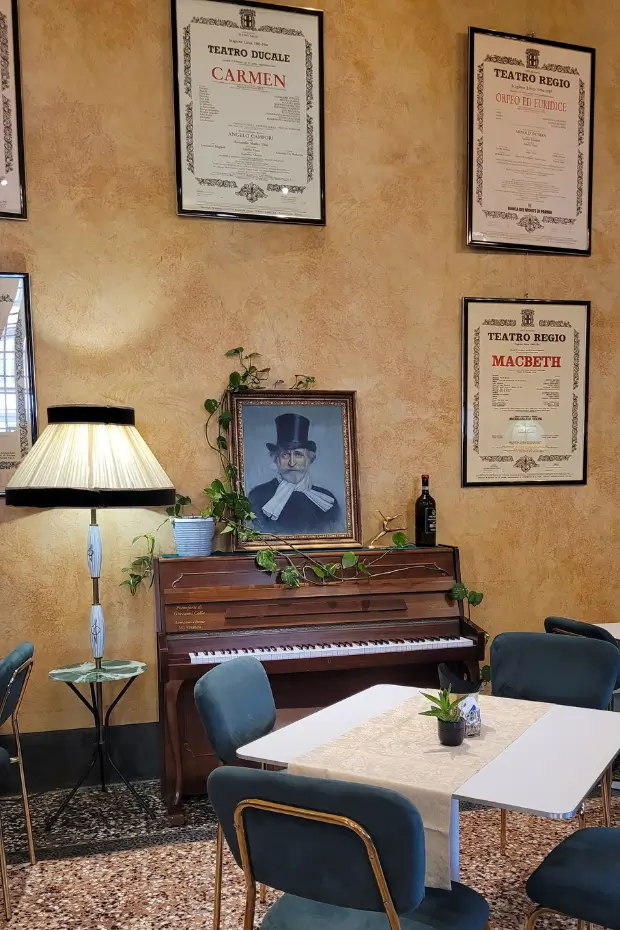
Back in the city, the Teatro Regio is Parma’s opera house, built in 1829 and one of the most important opera venues in Italy. Parma’s opera audience is famously demanding. A performance here is not background culture. It is taken seriously by an audience that has been listening to Verdi since childhood and knows exactly what a good performance sounds like. An evening at the Teatro Regio is a different experience from an evening at La Scala or the Arena di Verona. It is smaller, more intimate, and the audience is more engaged.
The Verdi connection runs through the city in ways that are easy to miss if nobody points them out. Music festivals, the Casa della Musica, streets and piazzas named after composers. Parma does not wear its musical identity loudly. It simply assumes you already know.
“Vanya organised a fantastic tour of Bologna, Emilia-Romagna and Lake Garda for us. Her attention to detail was fantastic and she made a real effort to make sure she found us really nice accommodation and informative days out. We had a wonderful time and we are going to ask her to organise a trip to Rome, Naples and the Amalfi Coast for us next year.”
— P.Foster., UK — October tailor-made trip, Bologna, Emilia-Romagna and Lake Garda
If Parma is on your list and you are not sure how to fit it in, that is where I can help.
START THE CONVERSATION
CORREGGIO AND THE CATHEDRAL DOME
the fresco that changes how you see the ceiling
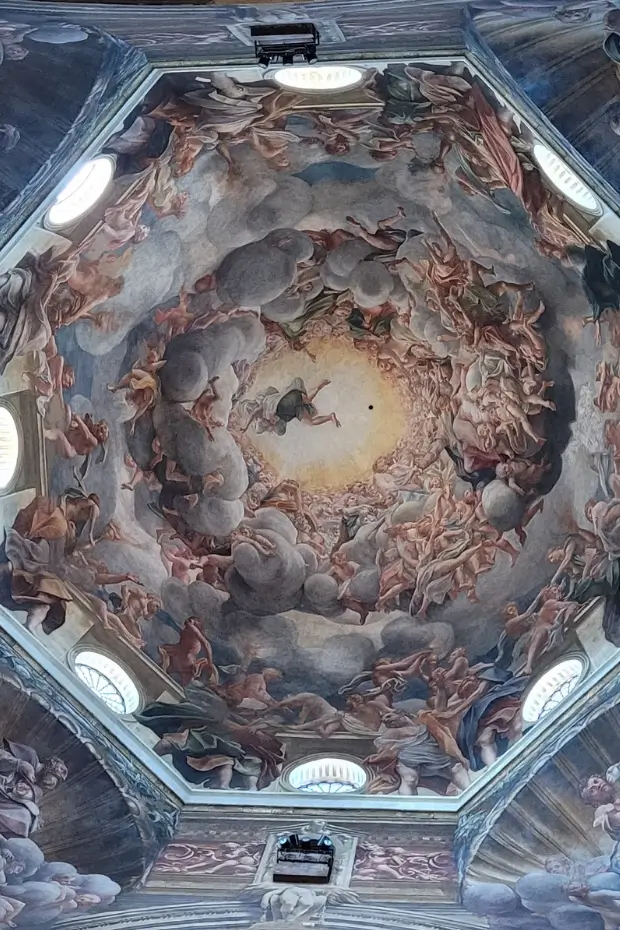
Correggio painted the dome of Parma Cathedral between 1526 and 1530. The subject is the Assumption of the Virgin Mary ascending to heaven, surrounded by apostles, angels, and clouds that spiral upward toward a point of light at the centre. The technique is called di sotto in su, painted from below looking up, with figures foreshortened to appear as if they are genuinely above you and moving.
Standing directly under it, the dome does not read as a flat surface with paint on it. It reads as an opening. The figures appear to be ascending in real space. Correggio achieved this four decades before the technique became common in Italian painting, which is part of why art historians consider it one of the most significant ceiling paintings of the Renaissance. The other part is that it works. It still does exactly what Correggio intended it to do.
The Cathedral is free to enter. The dome is above the crossing, visible from the nave. You do not need a ticket, a guide, or a reservation. You need to look up.
Parmigianino, the other great painter associated with Parma, painted the vault of the Steccata church a short walk away. The two are worth seeing on the same visit. Together they make Parma one of the most significant cities in Italy for Renaissance fresco painting, a fact that appears in almost no standard Italy itinerary.
THE PACE AND THE COLOUR
what Parma feels like to walk through
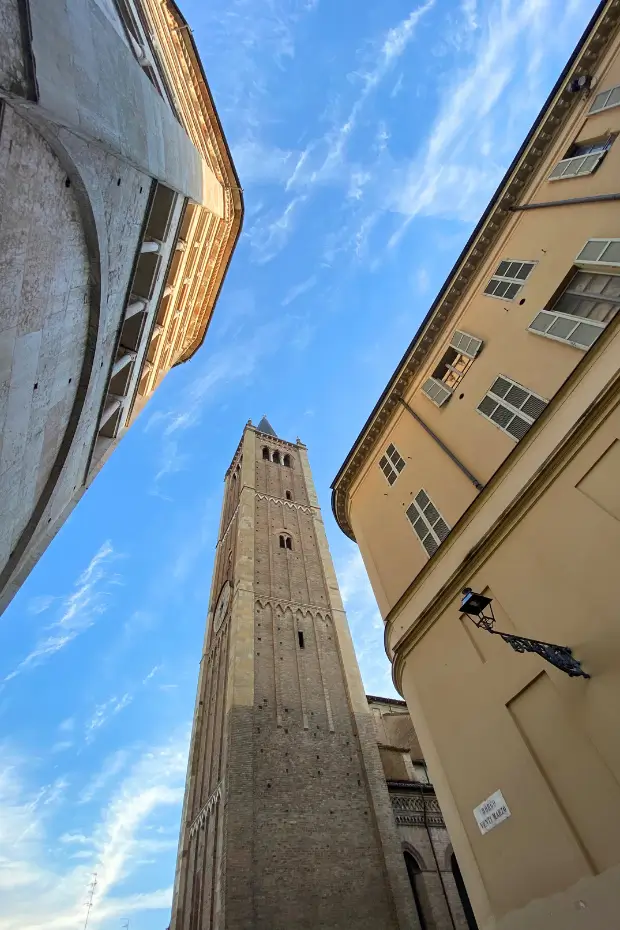
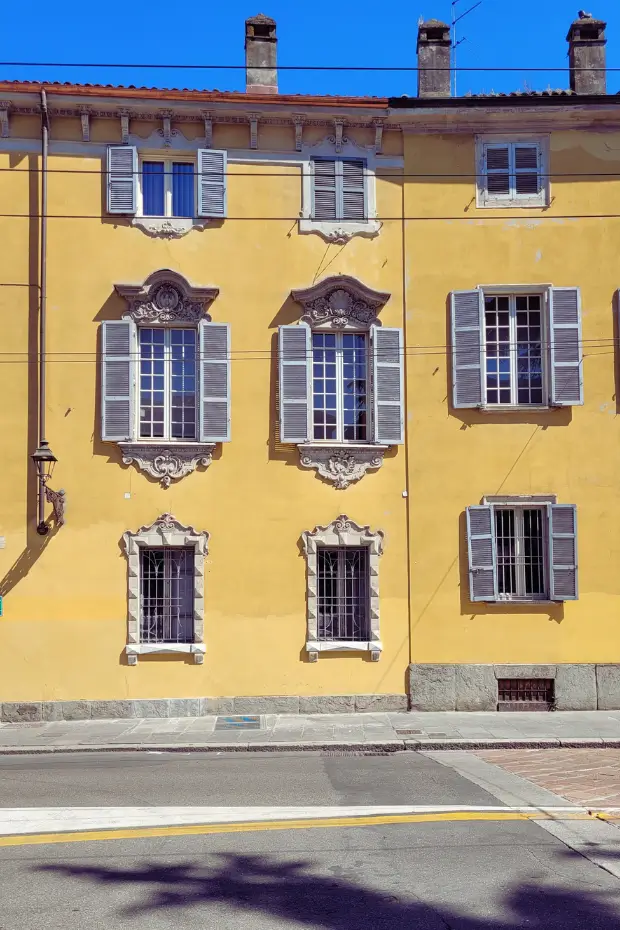
Parma is painted yellow. Not uniformly, not every building, but enough that the colour defines the city in a way that is specific to this place. The shade has its own name, giallo di Parma, Parma yellow, a warm ochre that appears on palazzo facades, on side streets, on buildings that have been this colour for centuries. The ornate Baroque window surrounds in grey stone against the yellow facades give Parma a visual identity that photographs do not fully capture. The centre feels bright and joyful in a way that is specific to this city.
The pace is unhurried. A stop for gelato. A coffee at a bar with no particular reason to leave. Artisan shops along streets that are neither purely tourist-facing nor purely local. Nobody is rushing. The city is compact enough that everything worth seeing is reachable on foot, which makes it genuinely easy with children and comfortable without a fixed agenda.
Most visitors to Parma come for half a day. They see the Cathedral, walk the centre, eat something, and leave. The city rewards staying longer. A full day gives you the Teatro Farnese and the Correggio dome without rushing. Two days gives you the Food Valley. Three days gives you Roncole Verdi, the countryside, and the slower version of Emilia-Romagna that most of northern Italy no longer has time for.
That is what makes Parma worth visiting. Not one thing. The combination of all five.
IS PARMA WORTH VISITING?
— the honest answer
Yes. Parma is worth visiting, and it is worth more time than most Italy itineraries give it.
The Food Valley alone justifies a two-day stay. The Cathedral, the Baptistery, and the Teatro Farnese justify another. Add the Correggio dome, a morning at Roncole Verdi, and the pace of a city that has not been reshaped around tourism, and Parma becomes one of the most complete stops in northern Italy.
It works as a standalone destination. It works as part of a longer route. It works for couples who want food and culture without the crowds, and for families who need somewhere compact, walkable, and genuinely engaging for all ages.
I plan Parma into Italy itineraries for both. If you want to understand how it might fit into yours, the first conversation is free. At Design Your Italy, I build Italy itineraries around what you specifically want, not around what already exists.
PARMA, ITALY
— your questions, answered honestly
Is Parma worth visiting in Italy?
Yes, and it is worth more time than most Italy itineraries give it. Parma sits in the heart of Emilia-Romagna, one of the most food-significant regions in the country, and the city itself has enough cultural depth — the Correggio dome, the Teatro Farnese, the Verdi connection, the pace of a city that has not been reshaped around tourism — to justify a stay of two days or more. It works as a standalone destination for couples who want northern Italy without the crowds, and as a compact, walkable stop for families.
The Food Valley around it, the Parmigiano Reggiano dairies and the Parma ham producers, requires at least another day to do properly. Parma worth visiting is not a question of whether but of how long.
Is Parma family friendly?
Very. It is one of the most practical Italian cities for families precisely because of its scale. The historic centre is compact and almost entirely flat, no hills, no long distances between the main sites. The Piazza del Duomo, the Baptistery, and the Palazzo della Pilotta are all within easy walking distance of each other. Cafes and bars are throughout the centre, which matters when you are travelling with children who need to stop.
The Food Valley experiences work for families too. A Parmigiano Reggiano dairy visit, watching a wheel being formed, seeing the ageing cellar, tasting cheeses of different ages, is genuinely engaging for children old enough to understand what they are looking at. The farm animals at a filiera chiusa dairy add another layer for younger children.
Parma also has the Parco Ducale, a large formal garden a short walk from the centre, useful for families who need outdoor space between cultural visits.
For families planning a northern Italy itinerary, Parma works well as a one or two night stop between Milan and Bologna, or as a base for a wider family holiday in Italy. I have also written about what to do in Milan beyond the obvious for anyone who wants more than a day in the city.
What is Parma Italy known for beyond the food?
Parma worth visiting is a question most people answer with cheese and ham. Both are correct and both deserve more time than a day trip allows. But Parma has a cultural depth that most Italy itineraries miss entirely.
The Correggio dome in the Cathedral is one of the most technically significant ceiling paintings of the Renaissance. Painted between 1526 and 1530, the Assumption of the Virgin uses an extreme upward perspective, di sotto in su, that makes the figures appear to be ascending above you in real space. It is free to enter and almost always uncrowded.
The Teatro Farnese inside the Palazzo della Pilotta is a 17th-century theatre built entirely in wood, constructed in 1618 and inaugurated once in 1628 before being largely forgotten. The scale inside is disorienting in the best possible way.
Parma is also the city of Giuseppe Verdi. The Teatro Regio is one of the most important opera houses in Italy, with an audience that has been listening to Verdi since childhood and takes a performance seriously. The birthplace of Verdi in Roncole Verdi, 14 kilometres outside the city, is worth the drive.
For couples planning a tailor-made couples holiday in Italy that goes beyond the standard circuit, Parma delivers food, art, architecture, and music in a city that has not been reshaped around mass tourism.
How long should you spend in Parma?
More than most Italy itineraries allow. The standard advice is a day trip from Bologna or Milan. That is enough to walk the centre, see the Cathedral, and eat well. It is not enough to understand what makes Parma worth visiting.
Two days in the city gives you the Cathedral and Baptistery, the Palazzo della Pilotta and the Teatro Farnese, the Correggio dome, an evening at or near the Teatro Regio, and time to walk the centre without rushing. That is the minimum for the city itself.
Add the Food Valley, and you need at least two more days. A Parmigiano Reggiano dairy visit takes a morning. A Parma ham producer visit takes another. These are not activities you combine into a single day without losing the point of both.
For families, two to three days covers the city comfortably with time for the Parco Ducale and a slower pace. For couples who want the full Food Valley experience alongside the cultural programme, three days gives everything enough time.
Roncole Verdi, the birthplace of Giuseppe Verdi 14 kilometres outside the city, adds a half day if the Verdi connection matters to you.
Parma is not a day trip destination. It is a city that makes more sense the longer you stay. Build in at least two days for the city, two more for the Food Valley, and you will still leave with a list of reasons to come back.
Autumn is one of the strongest seasons to visit the Food Valley. If you are planning an autumn holiday in Italy with a cultural and culinary focus, Emilia-Romagna pairs naturally with truffle country in Umbria or Piedmont as part of a wider northern and central Italy route.
Is it better to visit Parma or Modena?
They are different cities serving different interests and the honest answer is that the choice depends on what you want from Emilia-Romagna and who is travelling.
Modena is the city of balsamic vinegar, Lambrusco, and Ferrari. The traditional balsamic acetaie outside Modena, where the vinegar ages in a succession of barrels over a minimum of 12 years, are among the most interesting food experiences in northern Italy. The visitor infrastructure around the acetaie, the Ferrari museums, and the food scene is well developed and genuinely worth the time. The Cathedral and Piazza Grande are UNESCO listed. Osteria Francescana, three Michelin stars and regularly ranked among the best restaurants in the world, is in Modena.
Parma has more architectural and cultural depth. The Correggio dome, the Teatro Farnese, the Verdi connection, and the giallo di Parma colour that defines the city visually give it a character that is specific to this place. The Parma ham and Parmigiano Reggiano Food Valley gives it a food identity that extends well beyond the city itself.
For most Italy itineraries the better question is not which city but whether there is time for both. Modena is also the birthplace of Luciano Pavarotti, born in 1935 in Quartirolo just outside the city. The Casa Natale di Luciano Pavarotti can be visited. For anyone with a connection to opera, Parma and Modena together give you Verdi and Pavarotti, two of the most significant figures in the history of Italian opera, born 56 kilometres, 35 miles, apart. That alone makes the case for including both.
For a tailor-made Italy holiday that builds Emilia-Romagna properly, both cities belong in the itinerary. But if you have to choose one, it has to serve your specific interests, goals, time, and who is travelling. A family with teenagers may find the Ferrari museums and the Pavarotti birthplace in Modena more engaging than an afternoon in a cheese cellar. The right city is the one that fits the people taking the trip.