A Dolomites winter family trip does not have to involve skiing. If your family does not ski, or does not all ski, it is easy to assume the mountains in winter are not for you and to rule them out. They are, and often the trip is better for it.
Dolomites winter family activities for non-skiers run from high-altitude cable car trips and snowshoeing to sleigh rides, long lunches in a mountain stube and afternoons in the spa. Without ski school timetables and lift passes shaping the days, the pace slows down, and the focus shifts to the landscape, the food and the time together, which for many families is the whole point of a winter trip.
This is what a Dolomites winter family trip without skiing can look like, and how to plan it around what your family actually wants.
WHY THE DOLOMITES WORK FOR A NON-SKIING FAMILY
— you are not missing out
If your family does not ski, you are not missing out on a Dolomites winter trip. There is more to do here than most families can fit into a single visit, and very little of it depends on the slopes. The Dolomites are one of the strongest choices for a winter holiday in Italy, and they work just as well for families who never touch a ski.
The Dolomites are a UNESCO World Heritage site, recognised for two things, their natural beauty and their geological significance. Both are there for any visitor, skier or not. A winter trip built around the landscape rather than the ski runs shifts the focus from sport to the mountains themselves, the walks, the views, the food and the villages.
There is also the pace. A winter trip here without skiing tends to be a slower one, built around fewer things done well rather than a packed schedule. For families who spend the rest of the year rushing, that slower rhythm is often the real reason the trip works, more than any single activity.
The activities themselves are the rest of this. Here is what a Dolomites winter family trip without skiing can actually be built around.
DOLOMITES WINTER FAMILY ACTIVITIES FOR NON-SKIERS
— what to actually do beyond the slopes
HIGH ALTITUDE WITHOUT SKIS
the peaks and the views by cable car
Getting up to the high peaks is one of the simplest Dolomites winter family activities for non-skiers, because the cable cars do the work and no skis are needed. Across the Dolomites there are several points where a cable car takes you straight up to the views without a pair of skis in sight. Sass Pordoi in Val di Fassa reaches the Terrace of the Dolomites at 2,950 metres, with views across the Marmolada, the Sella group and the Catinaccio.
In Alto Adige, the Alpe di Siusi opens onto the largest high-altitude meadow in Europe, gentle and well suited to families, and Seceda above Ortisei gives you the dramatic ridgeline in a few minutes from the valley. Near Cortina, Lagazuoi climbs to 2,778 metres, with a rifugio and wide views at the top.
Wherever you go up, there is usually a rifugio at the summit, so the trip works around the views and a warm lunch rather than any effort, which suits families with younger children or grandparents as easily as teens.
For families who want more than a day trip up the mountain, some high-altitude rifugi in the Dolomites offer overnight stays with half board. Staying at altitude means you are there for sunrise and sunset, when the rock takes on colour and the crowds are gone, without the early journey up from the valley. It takes planning, as which huts open in winter and the cable car times both vary through the season, so it is worth working out in advance rather than leaving to chance.
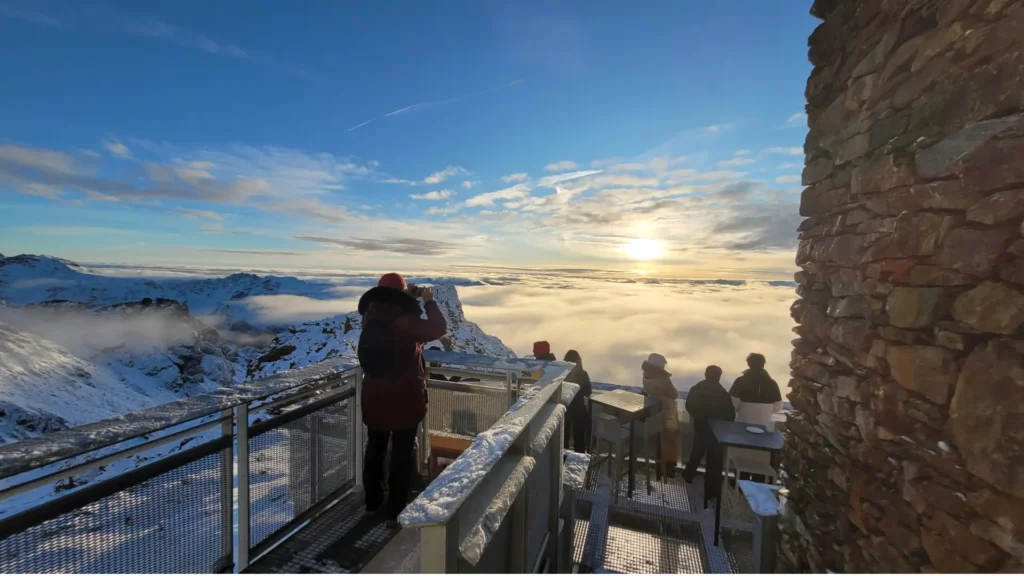
A few practical things make the high-altitude days work. The temperature gap between the valley and the summit is significant, so proper layers matter, thermals, a fleece, a windproof jacket, a warm hat, gloves and waterproof boots for everyone. Timing is the other thing. The cable car hours and, if you are chasing a sunrise or sunset from a hut, the light times shift through the winter, so the day has to be built around them rather than the other way around. And it is worth balancing a high-altitude morning with a slower afternoon, so the pace suits the whole family rather than only the most energetic in it.
SNOWSHOEING IN THE DOLOMITES FOR THE WHOLE FAMILY
if you can walk, you can snowshoe
Snowshoeing is one of the best Dolomites winter family activities for non-skiers, because there is almost no learning curve. If you can walk, you can snowshoe. Locally it is called ciaspole, and it lets a family of mixed ages explore quiet, snow-covered forests well away from the ski slopes and the crowds.
The Seiser Alm and the Fassa Valley have a wide range of easy trails, including gentle, interactive routes that work well for younger children. Many of the higher trails are reached by cable car, so you get the views over the Sassolungo, Sciliar and Catinaccio without a hard climb to reach them.
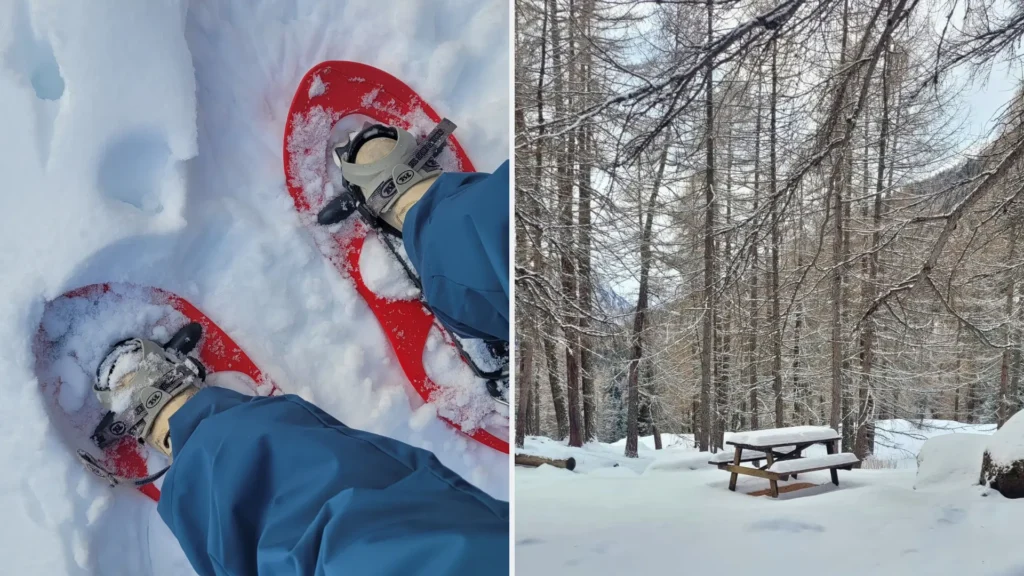
A local guide is worth considering, and not only for safety. A good one tailors the route to the family’s fitness and turns the walk into something that holds children’s attention, reading animal tracks in the fresh snow and telling the Alpine legends and Ladin history of the area. It shifts the day from a walk to an experience, which for families with children makes the difference.
A few practical things help. Snowshoes and poles can be rented locally or come with a guided tour. Everyone needs proper layers and waterproof boots that fit the bindings. Routes are graded by difficulty, so flat forest trails suit younger children while teenagers tend to prefer routes with some climb and a viewpoint at the end. And it is worth knowing that snowshoeing takes roughly twice the effort of ordinary walking, so a shorter route than you would normally choose is usually the right call with a family.
CULINARY EXPERIENCE IN THE DOLOMITES
the stube, the food, and the culture in it
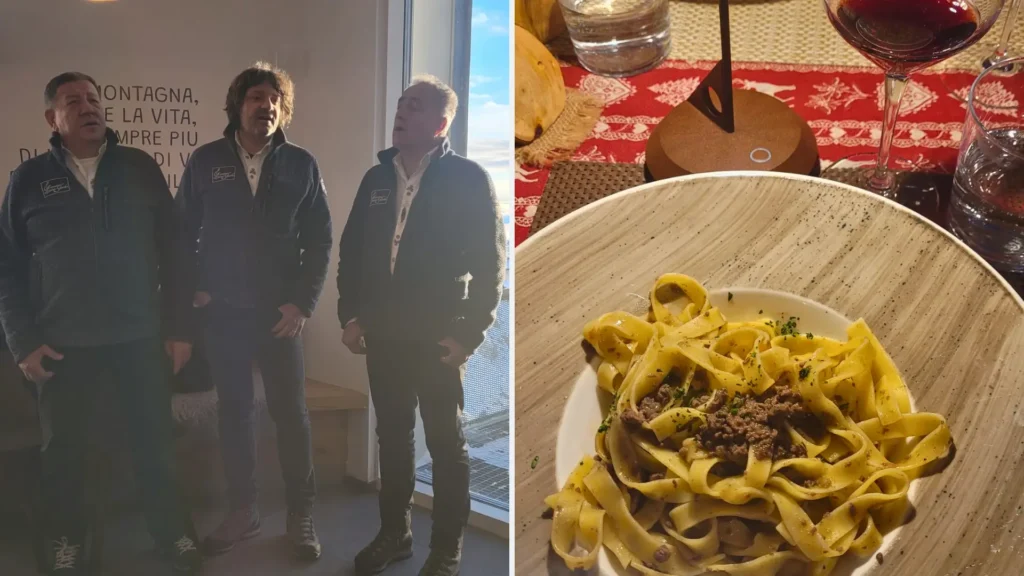
In Italy, eating is one of the ways you get closer to a place, and in the Dolomites that is especially true. The Alpine cuisine has a community spirit to it, built on seasonal, local ingredients, and sitting down to a long meal here is a Dolomites winter family activity in its own right rather than just a stop between others.
Much of it happens in a stube, the traditional wood-panelled room found in mountain huts, hotels and village restaurants across the Dolomites. It is warm, low-ceilinged and homely, the kind of room that draws a family in from the cold and keeps them at the table longer than they planned.
The food is honest and regional. Canederli, the bread dumplings served in broth or with butter, speck, the local cured ham, polenta with mountain cheese, pappardelle with venison ragù, and the strudels and cakes that follow. It changes with the season and the valley, so a meal in Alta Badia is not quite the same as one in Val di Fassa.
For families, this is one of the easiest things to build into a trip and often one of the most remembered. A guided snowshoe walk that ends at a rifugio for lunch, a slow dinner in a stube after a day out, or simply a long meal on the afternoon the weather turns. It asks nothing of anyone except to sit down and eat well, which with children and mixed ages is sometimes exactly what the day needs.
WELLNESS AND SPA IN THE DOLOMITES
saunas, pools, and mountains through the window
The Dolomites have a genuine Alpine wellness tradition, and it is one of the reasons the region works so well for a winter trip that is not built around skiing. Many of the hotels have serious spa areas, saunas, steam rooms, indoor and outdoor pools that stay warm while the air outside is freezing, and treatments that use local mountain botanicals. After a day out in the cold, or on the afternoon the weather turns, this is the part of the trip that asks nothing of anyone.
For families it works in a few ways. It is a relaxing day in its own right, a day with nothing planned beyond the pool and the sauna and the mountain outside the window. It is also the recovery after an active morning of snowshoeing or a day up the mountain, and the fallback when the weather does not cooperate, which in winter it sometimes will not.
The one thing worth checking in advance is age policy. Some spa areas have restrictions for younger children, but there are also genuinely family-friendly hotels with pools and wellness areas designed for children as much as adults, so a family travelling with young ones is not left out.
Choosing the right hotel matters more here than most people expect, because the wellness side can shape the whole feel of the trip. I have written about three hotels in the Dolomites where the wellness is a genuine reason to stay, worth a look if this is the kind of trip you are planning.
SLEIGH RIDES AND DOG SLEDDING IN THE DOLOMITES
experiencing the snow without skis
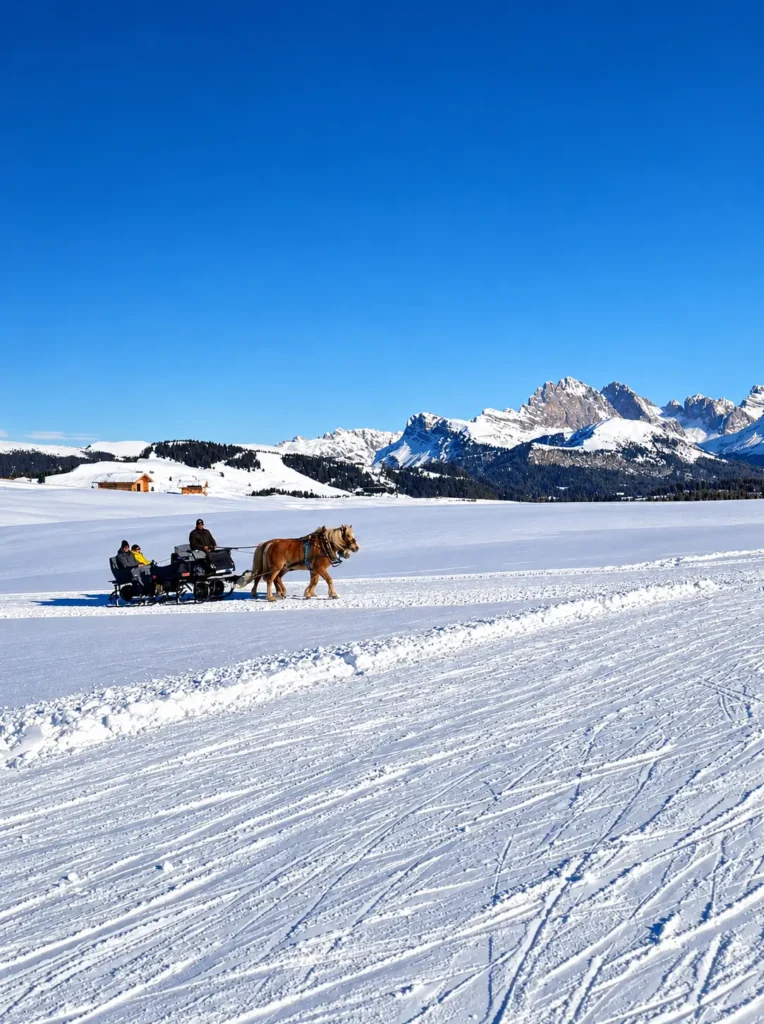
Not everything in the snow has to be active. A horse-drawn sleigh ride is one of the calmest Dolomites winter family activities for non-skiers, and one that tends to land with children and grandparents alike. Wrapped in blankets, with the bells on the harness and the snow-covered valley moving slowly past, it asks nothing of anyone except to sit and take it in.
South Tyrol has a real tradition of it. The sleighs are usually drawn by Haflinger horses, the small, strong, ginger-coloured breed native to the region, and there are established routes across several valleys. In Val Gardena the rides run through the areas around Col Raiser and the Pana pasture. In Dobbiaco, a sleigh trip from the cross-country centre leads out toward Lake Toblach, where you can stop for a hot drink before the return. Antholz and other valleys have their own routes, by day and, in some places, at night.
For families who want something more active, dog sledding is the other option, guiding or riding behind a team of huskies across the snow. It is a bigger, louder, more hands-on experience than the sleigh, and it works well for older children and teenagers who want a story to tell rather than a quiet ride. Both are the kind of thing that needs booking ahead in winter, as the operators and the routes are limited and fill up.
HOW TO PLAN A DOLOMITES WINTER FAMILY TRIP
— timing, length and what to know
The peak of the winter season runs from around Christmas to the sixth of January, when the festive period, the Christmas markets and the deep snow come together, and rates and demand are at their highest. January is one of the best months to go once that peak has passed. The snow is reliable, the valleys are quieter, and the prices ease, though the Christmas markets have finished by then.
February and March bring lower rates again, but for families they are trickier to time, because they depend on school breaks. Without a half-term to work around, those months can suit families with grown-up children more than those with school-age ones.
Where you base yourself matters less for a non-skiing family than it does for skiers. If you are not tied to a particular ski area and its lifts, you have more freedom to choose a base for the setting, the hotel and the activities around it rather than for how close it sits to the slopes. That is one of the quiet advantages of a non-ski trip.
On length, three to four nights works if the Dolomites are one part of a wider winter trip through the north. For a proper winter holiday, a week or more is better, and worth knowing that some hotels only accept weekly stays in high season, which shapes the options for shorter trips. This is also where how to plan a family trip to Italy is worth reading, because pacing a longer trip well is what keeps it from becoming tiring. Shorter stays come with more limited accommodation and less flexibility, so booking ahead matters.
Many things can be arranged once you are there, but the winter season, the hut openings, the sleigh operators and the better hotels all fill up, so planning in advance rather than on arrival makes a real difference.
Getting to and around the Dolomites in winter takes some thought too, particularly with snow on the roads and transfers from the nearest airports or train stations. Getting around Italy covers the practical side of moving between places on a wider trip.
Winter is only one side of the Dolomites for families. They work just as well in summer, in a completely different way, which I’ve written about in planning a Dolomites family holiday.
THE DOLOMITES IN WINTER FOR EVERY AGE
— when not everyone skis
A Dolomites winter trip without skiing works across a wider range of a family than skiing does, because nobody is left out for not being on the slopes.
With young children, the appeal is the snow itself and the gentler activities, a short snowshoe walk, a sleigh ride, time in a family-friendly pool, a warm lunch in a stube. The one thing to check in advance is that the hotel and its wellness areas genuinely welcome young children, as some do not, though many are built for exactly this.
Teenagers want something with a bit more to it, and the same trip delivers that too, dog sledding, a longer snowshoe route to a viewpoint, a cable car to a high peak. The ones who have grown tired of being walked through museums tend to stay engaged when the day involves doing something in the snow.
Where it comes into its own is across three generations. A non-ski winter trip is often easier to plan than a ski one, because it does not depend on everyone having the same ability or wanting the same thing. Grandparents can take the cable car up for the views and lunch while others snowshoe, and everyone meets for dinner in the same stube.
That flexibility is the real reason it works. A Dolomites winter family trip without skiing gives each person their own version of the day, and still brings everyone back to the same table at the end of it.
None of this depends on skiing, and none of it requires everyone in the family to want the same thing on the same day. That is what makes the Dolomites work in winter for a family that does not ski. The high peaks for one, the spa for another, a snowshoe walk and a long lunch for everyone, planned around who is travelling and what the weather is doing. Put together properly, a Dolomites winter trip without skiing is not a compromise. It is often the better version of the trip. It is often the better version of the trip, and it is the kind of family holiday in Italy I plan around who is actually travelling.
DOLOMITES WINTER FAMILY ACTIVITIES FOR NON-SKIERS
— your questions, answered honestly
Is the Dolomites worth visiting in winter if you don’t ski?
Yes, and for a lot of families the trip is better for it. Skiing is only one part of what the Dolomites offer in winter, and once you take it out, what remains is a mountain landscape that works for every age. Cable cars take you up to the high peaks for the views and a warm lunch without a pair of skis. Snowshoeing lets anyone who can walk explore the quiet forests.
There are sleigh rides, dog sledding, long meals in a traditional stube, and hotel spas built for the cold. Without ski school and lift times shaping the days, the pace is slower and the trip tends to be easier on everyone, which for a family is often the point.
What are the best winter activities for families in the Dolomites?
The best ones need no skiing and work across different ages. Taking a cable car up to a high peak like Sass Pordoi gives you the views and a rifugio lunch without any effort, which suits everyone from young children to grandparents. Snowshoeing, called ciaspole locally, has almost no learning curve and lets a family walk into quiet forests away from the slopes. Sleigh rides pulled by Haflinger horses are calm and gentle, while dog sledding is louder and more hands-on for older children and teenagers.
A long lunch or dinner in a traditional stube is an activity in its own right, built around the seasonal Alpine food. And the hotel spas, with their saunas and warm pools, give the family a slower day whenever they want one. Most families combine several of these, and a winter trip built around them rather than the slopes works genuinely well for a family that does not ski.
Is a winter Dolomites trip suitable for young children or grandparents who don’t walk far?
Yes, because most of the best activities do not depend on being fit or walking far. You reach the high peaks by cable car rather than on foot, so getting up for the views and a warm lunch is possible for young children and grandparents alike, with no effort involved. Sleigh rides are gentle and require nothing but sitting back under a blanket. Snowshoeing can be as short and flat as you want, and the stube lunches and hotel spas ask nothing physical at all.
The one thing worth checking in advance is the hotel’s age policy for its wellness areas, as some spas restrict younger children, though many hotels are genuinely set up for families with small ones. Planned around the right pace, a Dolomites winter trip works as well for a three-year-old or an eighty-year-old as it does for a teenager.
When is the best time for a family winter trip to the Dolomites?
It depends on what you want and when you can travel. The peak runs from Christmas to around the sixth of January, when the festive atmosphere, the Christmas markets and the snow all come together, and it is the busiest and priciest time. January, once that peak passes, is one of the best months. The snow is reliable, the valleys are quieter and prices ease, though the Christmas markets have finished by then.
February and March bring lower rates again, but for families they are harder to time because they depend on school breaks. Without a half-term to work around, those months tend to suit families with grown-up children more than those with school-age ones. There is no single best time. It comes down to whether you want the Christmas atmosphere, the quieter deep-winter weeks, or the later season, and how that fits with school and work.
How far in advance should you plan a Dolomites winter family trip?
The earlier the better, particularly for a trip in the peak weeks around Christmas and New Year. The winter season in the Dolomites is short and busy, and the things that make a non-ski trip work, the better family-friendly hotels, the hut openings, the sleigh and dog-sledding operators, all have limited availability and fill up. Some hotels also only take weekly stays in high season, which shapes the options if you are planning a shorter trip.
A lot can still be arranged closer to the date, but the strongest options tend to go first, so planning several months ahead gives you the best of them rather than what is left. It also allows the trip to be built around the weather and the family’s pace rather than assembled in a rush. If you would like that done for you, this is the kind of Dolomites winter family trip I plan.